

Interactive 3-3-3 Grounding Guide
Current Step
Anxiety thrives on vague fears. Reality is concrete.
Let's bring your focus back to the here and now.
Progress
Your Observations
- No observations yet...
Excellent Work!
You have successfully engaged your senses and grounded yourself. Take another deep breath. You are safe in the present moment.
Have you ever felt your heart racing for no obvious reason, or found yourself spiraling into worry during a quiet moment? You are not alone. In our fast-paced world, stress and anxiety can hit us without warning. That is where simple tools like the 3-3-3 rule come in handy. It is not magic, but it is a powerful way to snap out of panic and return to the present moment.
The 3-3-3 rule is a grounding technique designed to help you manage anxiety by engaging your senses. It shifts your focus from internal worries to external reality. By naming what you see, hear, and feel physically, you interrupt the cycle of negative thoughts. This method is quick, requires no equipment, and works anywhere-whether you are at work, in public, or lying awake at night.
Understanding the Mechanics of Grounding
To understand why this works, we need to look at how our brains handle stress. When anxiety spikes, your amygdala-the brain's alarm system-takes over. It triggers the "fight or flight" response, flooding your body with adrenaline. Your logical prefrontal cortex goes offline. You might feel detached, dizzy, or overwhelmed.
Grounding pulls you back into the "here and now." It forces your brain to process sensory input rather than catastrophic predictions about the future. The 3-3-3 rule specifically uses three channels: sight, sound, and movement. This multi-sensory approach creates a strong anchor in reality.
Step-by-Step: How to Practice the 3-3-3 Rule
You do not need special training to use this technique. Here is exactly how to do it when you feel tension rising:
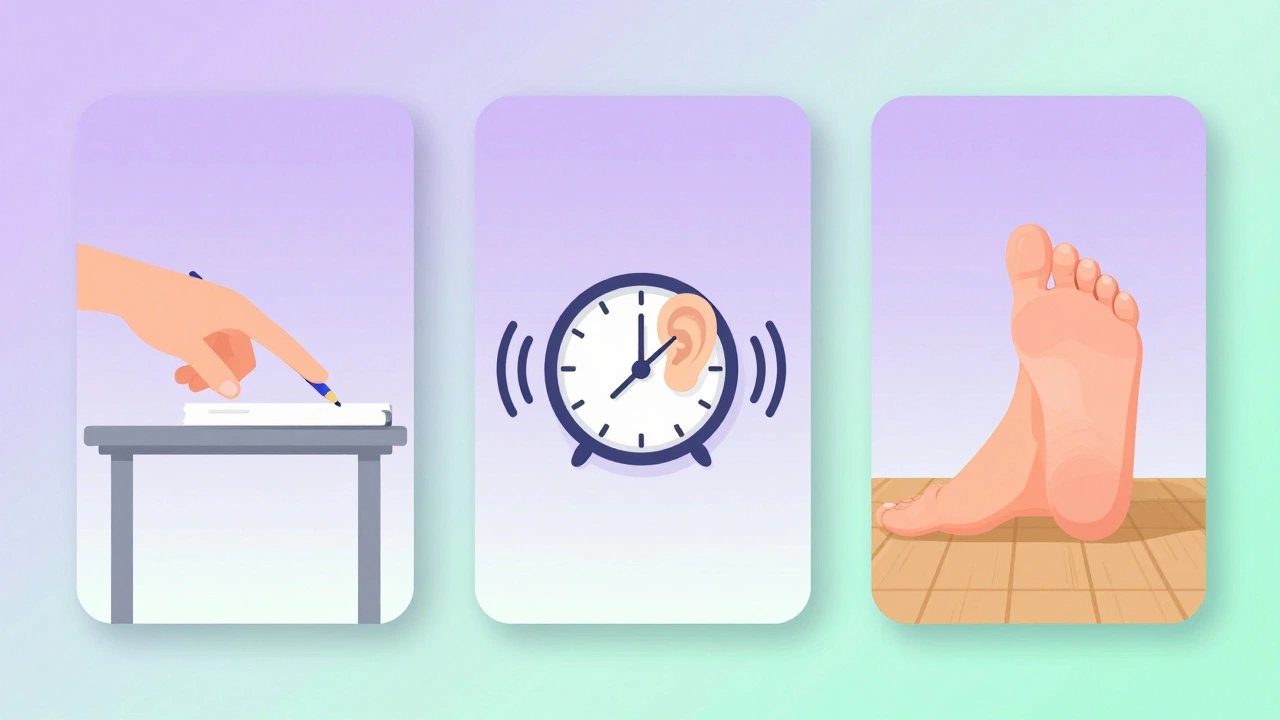
- Name three things you can see. Look around you. Do not just glance; really observe. Maybe you see a blue pen, a crack in the wall, or sunlight hitting the floor. Say them out loud or whisper them to yourself. "I see a lamp. I see a plant. I see my shoes."
- Name three sounds you can hear. Close your eyes if it helps. Listen deeply. Is there traffic outside? A clock ticking? The hum of the refrigerator? Identify three distinct noises. "I hear birds. I hear typing. I hear breathing."
- Move three parts of your body. Wiggle your toes. Flex your fingers. Roll your shoulders. These small movements remind your brain that you are safe in your physical body and break the freeze response often associated with panic.
This entire process takes less than two minutes. The key is to be specific. Instead of saying "I see furniture," say "I see a wooden chair." Specificity engages your cognitive processing more effectively.
Why Does This Technique Work?
The science behind the 3-3-3 rule lies in attention redirection. Anxiety thrives on vague, abstract fears. Reality is concrete and specific. By forcing your brain to catalog concrete details, you occupy the neural pathways that would otherwise loop through anxious thoughts.
| Sense | Action | Psychological Effect |
|---|---|---|
| Vision | Naming objects | Reduces visual hallucinations or tunnel vision caused by panic |
| Hearing | Identifying sounds | Lowers auditory sensitivity and calms the nervous system |
| Kinesthetic | Moving body parts | Releases physical tension and confirms bodily safety |
Additionally, speaking these observations aloud adds another layer of engagement. Vocalization slows down your speech pattern, which in turn slows down your heart rate. It is a physiological reset button.
When to Use the 3-3-3 Rule
This tool is versatile. You can use it proactively or reactively. Here are common scenarios where it shines:
- Social Anxiety: Before a meeting or party, use it to calm nerves and center yourself.
- Panic Attacks: If you feel chest tightness or rapid heartbeat, start the sequence immediately to prevent escalation.
- Insomnia: Lying in bed, name three things you can see in the dark room (or imagine them), three sounds in the house, and move three limbs gently.
- Overwhelm at Work: When tasks pile up, take 60 seconds to ground yourself before diving back in.
It is also useful for children who struggle with emotional regulation. Simplify the language: "Show me three things. Tell me three sounds. Move three body parts."
Common Mistakes to Avoid
Even simple techniques can fail if done incorrectly. Here is what to watch out for:
Rushing through the steps. The goal is mindfulness, not speed. If you blur through the list, you miss the calming effect. Take your time. Notice the texture of the object you see. Listen to the pitch of the sound you hear.
Forcing it when too agitated. If you are in severe distress, the 3-3-3 rule might feel impossible. In that case, try a simpler version: Name one thing you see, then breathe. Gradually build up to the full three-step process as you calm down.
Ignoring the physical component. Many people skip the movement part because they are sitting still. But moving your body is crucial for releasing stored stress energy. Even subtle movements count.
Alternatives and Complementary Techniques
The 3-3-3 rule is not the only grounding method. Some people prefer other variations. For example, the 5-4-3-2-1 technique involves five things you see, four you can touch, three you hear, two you smell, and one you taste. It is more detailed but takes longer.
Another option is box breathing: inhale for four counts, hold for four, exhale for four, hold for four. This focuses solely on breath control. Combining box breathing with the 3-3-3 rule can be highly effective. Breathe deeply while naming your surroundings.
Journaling is also a great complement. After using the 3-3-3 rule, write down what triggered your anxiety and how the exercise helped. This builds self-awareness over time.
Building a Long-Term Mindfulness Habit
Using the 3-3-3 rule occasionally is helpful, but practicing it regularly makes it more effective. Think of it like a muscle. The more you train it, the stronger it gets. Try incorporating short grounding sessions into your daily routine, even when you are not stressed. This prepares your brain to access the technique easily during crises.
Pair it with existing habits. Do the 3-3-3 rule while waiting for your coffee to brew. Or practice it during your morning commute. Consistency turns a crisis tool into a lifestyle habit.
Is the 3-3-3 rule scientifically proven?
While there are few studies specifically named "the 3-3-3 rule," it is based on well-established principles of cognitive behavioral therapy (CBT) and grounding techniques. Research supports that sensory grounding reduces symptoms of PTSD, anxiety, and panic disorders by interrupting maladaptive thought patterns.
Can I use the 3-3-3 rule if I have low vision or hearing loss?
Yes. Adapt the technique to your strengths. If you have low vision, focus on textures or temperatures you can feel. If you have hearing loss, emphasize visual details and physical movement. The core principle is engaging multiple senses, so adjust the inputs accordingly.
How long does it take to learn the 3-3-3 rule?
You can learn it in under a minute. However, mastering its application during high-stress moments may take a few days of practice. Start using it when you are calm to build familiarity before relying on it during anxiety spikes.
Does the order of the steps matter?
The traditional order is sight, sound, then movement. This progression moves from passive observation to active engagement. However, if one step feels easier to start with, begin there. The goal is to engage all three senses, regardless of sequence.
Can children use the 3-3-3 rule?
Absolutely. Children often respond well to structured activities. Make it a game: "Let's play I Spy with three things, listen for three sounds, and wiggle three body parts." This helps them develop emotional regulation skills early.