

Find Your Next Life-Changing Book
Have you ever bought a stack of motivational books with the best intentions, only to let them gather dust on your shelf? You are not alone. The self-help industry is flooded with titles promising overnight transformations, but most readers struggle to bridge the gap between reading advice and actually living it. The real question isn't just which book has the best ideas-it's which one will stick with you long enough to create measurable change.
Finding the best book to change life requires looking past the hype. It means identifying resources that offer actionable frameworks rather than vague inspiration. Whether you are struggling with procrastination, seeking financial freedom, or trying to build healthier relationships, the right book acts as a catalyst. Below, we break down seven highly impactful books that have stood the test of time, analyzing why they work and who they are for.
Why Most Self-Help Books Fail (And How to Fix It)
Before diving into specific titles, it is crucial to understand why so many people feel stuck after finishing a self-help book. The problem is rarely the content; it is the execution. Many books provide information overload without a clear implementation strategy. You read about the importance of discipline, but you don't get a step-by-step plan to build it.
To make a book truly change your life, you must treat it like a course, not a novel. Here is a simple heuristic:
- The 10% Rule: Do not try to implement every idea in the book. Pick one concept that resonates deeply and apply it for 30 days.
- Active Reading: Highlight key passages and write marginal notes. If you aren't interacting with the text, you aren't retaining it.
- Action Over Consumption: Close the book and do something. Read five pages, then take one small action related to those pages.
This approach shifts the focus from passive consumption to active transformation. Now, let’s look at the books that provide the best frameworks for this kind of deep work.
Atomic Habits by James Clear
Atomic Habits is a practical guide to building good habits and breaking bad ones by focusing on tiny, incremental changes. Written by James Clear, this book has become a modern classic because it moves away from goal-setting and focuses on system-building.
Clear argues that you do not rise to the level of your goals; you fall to the level of your systems. Instead of aiming to "lose 20 pounds," you design a system where healthy eating is the default choice. The core concept is the "1% better every day" philosophy. Small improvements compound over time, leading to remarkable results.
The book introduces the Four Laws of Behavior Change: Make it Obvious, Make it Attractive, Make it Easy, and Make it Satisfying. For example, if you want to read more, make it obvious by placing a book on your pillow. Make it attractive by pairing it with your morning coffee. Make it easy by starting with just two pages. This psychological framework makes habit formation feel less like a battle of willpower and more like a game of design.
Best for: People who struggle with consistency and want a scientific yet accessible approach to daily routines.
The Psychology of Money by Morgan Housel
The Psychology of Money is a collection of short chapters exploring how human behavior, emotions, and biases influence financial decisions. Unlike traditional finance books that focus on charts and algorithms, Morgan Housel focuses on the soft skills of money management.
Housel emphasizes that doing well with money has little to do with how smart you are and a lot to do with how you behave. He shares stories of wealthy individuals who went broke due to poor decision-making and modest earners who built wealth through patience and compounding. One key takeaway is the concept of "enough." Knowing when you have enough prevents risky behavior driven by greed or status anxiety.
The book also highlights the power of compounding, not just in investing, but in life. Warren Buffett’s wealth, for instance, is largely the result of decades of consistent returns, not just high annual gains. This perspective helps readers detach their self-worth from their net worth and focus on long-term stability.
Best for: Anyone feeling anxious about finances or seeking a philosophical shift in how they view wealth and success.
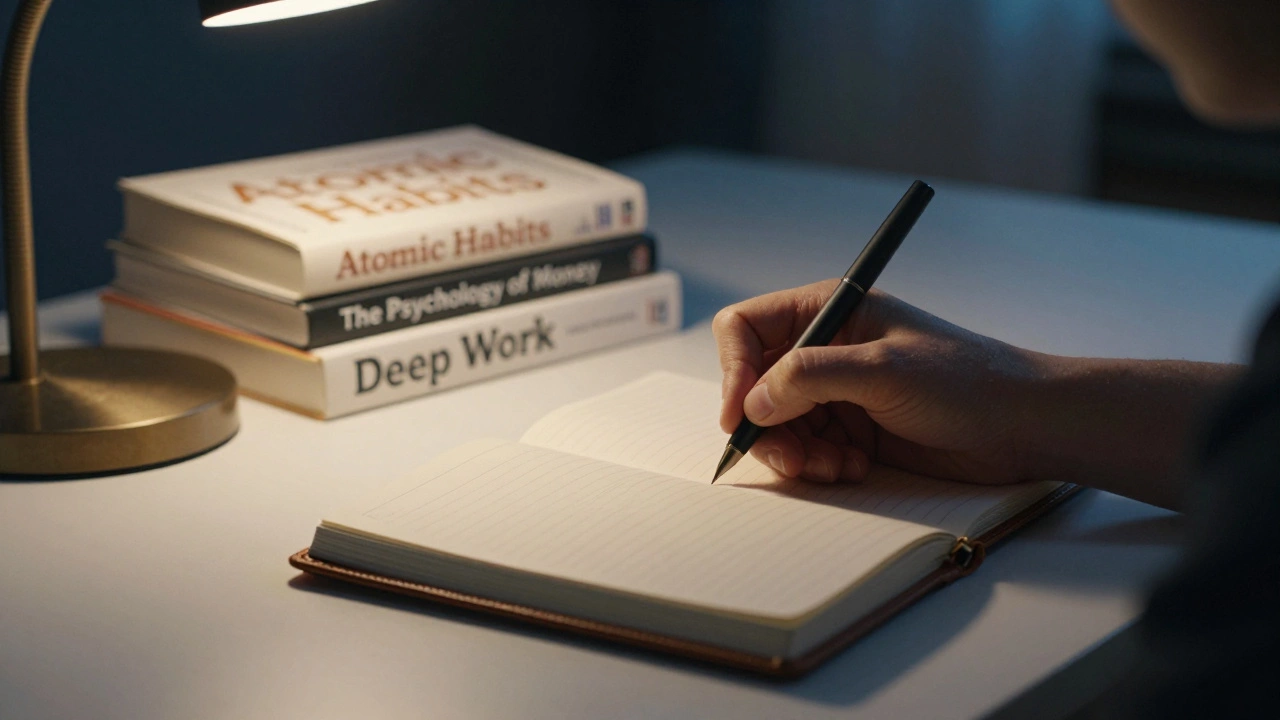
Deep Work by Cal Newport
Deep Work is a professional philosophy that advocates for intense, distraction-free concentration to produce high-quality output in a distracted world. Computer science professor Cal Newport argues that the ability to perform deep work is becoming increasingly rare and valuable.
In an era of constant notifications and shallow communication tools like email and Slack, our attention spans are fragmented. Newport defines deep work as professional activities performed in a state of distraction-free concentration that push your cognitive capabilities to their limit. These efforts create new value, improve your skill, and are hard to replicate.
The book provides four rules for cultivating deep work: Make Time Count, Embrace Boredom, Quit Social Media, and Drain the Shallows. For instance, he suggests scheduling blocks of time for deep work and treating them as unbreakable appointments. By reducing "shallow work"-tasks that do not require intense thinking-you free up mental energy for tasks that truly move the needle in your career or personal projects.
Best for: Knowledge workers, creatives, and students who feel overwhelmed by distractions and want to increase productivity and quality of output.
Thinking, Fast and Slow by Daniel Kahneman
Thinking, Fast and Slow is a groundbreaking exploration of the two systems that drive the way we think: System 1 (fast, intuitive) and System 2 (slow, deliberate). Nobel laureate Daniel Kahneman reveals the cognitive biases that lead us to irrational decisions.
Understanding these systems is crucial for making better choices in business, health, and relationships. System 1 operates automatically and quickly with little effort, while System 2 allocates attention to mentally demanding activities. We often rely too heavily on System 1, leading to errors like anchoring bias or loss aversion.
Kahneman explains concepts like the planning fallacy, where we underestimate the time, costs, and risks of future actions. By recognizing these mental shortcuts, you can pause and engage System 2 when making critical decisions. This book does not give you a quick fix; it gives you a lens through which to view your own mind, helping you avoid costly mistakes.
Best for: Readers interested in psychology, decision-making, and understanding why humans act irrationally.
Man's Search for Meaning by Viktor Frankl
Man's Search for Meaning is a memoir and philosophical reflection on finding purpose even in the most suffering-filled circumstances. Psychiatrist Viktor Frankl survived Nazi concentration camps and developed logotherapy, a method based on the premise that the primary drive in life is not pleasure, but the discovery and pursuit of what we find meaningful.
Frankl argues that everything can be taken from a man but one thing: the last of the human freedoms-to choose one's attitude in any given set of circumstances. This book is not a typical self-help manual; it is a profound reminder of human resilience. It challenges readers to ask not what they expect from life, but what life expects from them.
The second part of the book outlines how to apply logotherapy in practice, emphasizing that meaning can be found in work, love, or courage in the face of suffering. For anyone going through a crisis or existential doubt, this book offers a anchor of hope and perspective.
Best for: Individuals facing adversity, existential crises, or seeking a deeper sense of purpose beyond material success.

How to Win Friends and Influence People by Dale Carnegie
How to Win Friends and Influence People is a timeless guide to interpersonal skills, teaching principles for handling people, making people like you, and winning people to your way of thinking. First published in 1936 by Dale Carnegie, its advice remains relevant because human nature has not changed.
Carnegie’s core principle is simple: become genuinely interested in other people. He advises against complaining, criticizing, or condemning. Instead, give honest and sincere appreciation. Learn to remember names, smile, and listen attentively. These may seem like basic social skills, but mastering them can transform your professional and personal relationships.
The book provides concrete techniques, such as talking in terms of the other person’s interests and making the other person feel important-and doing it sincerely. In a world dominated by digital communication, these face-to-face interaction skills are more valuable than ever for leadership and networking.
Best for: Professionals, leaders, and anyone looking to improve their communication and relationship-building skills.
The Subtle Art of Not Giving a F*ck by Mark Manson
The Subtle Art of Not Giving a F*ck is a counterintuitive approach to living a good life by choosing what to care about and accepting responsibility for your happiness. Author Mark Manson challenges the positive-thinking culture that dominates self-help.
Manson argues that the desire for a more positive experience is itself a negative experience. By constantly striving to feel good, we judge our current reality as lacking. Instead, he proposes embracing uncertainty, failure, and discomfort. The key is to choose your struggles wisely. Every life is a series of problems; the difference lies in which problems you decide to tackle.
The book encourages readers to define their values clearly and live by them, even when it is difficult. It is a call to stop chasing fleeting pleasures and start pursuing meaningful responsibilities. With its blunt language and humorous tone, it resonates with younger audiences tired of toxic positivity.
Best for: Readers skeptical of traditional self-help and those seeking a realistic, no-nonsense approach to personal growth.
| Book Title | Primary Focus | Key Takeaway | Ideal Reader |
|---|---|---|---|
| Atomic Habits | Habit Formation | Small changes compound over time | Consistency seekers |
| The Psychology of Money | Financial Behavior | Wealth is a behavior, not just math | Finance beginners |
| Deep Work | Productivity | Focus is a superpower | Knowledge workers |
| Thinking, Fast and Slow | Decision Making | Awareness of cognitive biases | Analysts & Leaders |
| Man's Search for Meaning | Purpose & Resilience | Find meaning in suffering | Those in crisis |
| How to Win Friends... | Communication | Genuine interest in others | Professionals |
| The Subtle Art... | Values & Priorities | Choose your struggles wisely | Skeptics of positivity |
How to Choose the Right Book for You
With so many options, how do you pick the one that will actually help you? Start by diagnosing your current bottleneck. Are you lazy? Read Atomic Habits. Are you distracted? Read Deep Work. Are you anxious about money? Read The Psychology of Money.
Do not try to read all of them at once. Depth beats breadth. Commit to one book, apply its principles for a month, and measure the results. If you find yourself resisting the advice, ask why. Is the book wrong, or are you avoiding uncomfortable truths? Often, the resistance is where the growth happens.
Remember, a book is a tool, not a magic wand. The author cannot change your life for you. They can only provide the map. You have to walk the path. Start with one page, take one step, and see where it leads.
What is the single best book to change your life?
There is no single "best" book because individual needs vary. However, Atomic Habits by James Clear is widely considered the most actionable for general personal improvement because it provides a universal framework for behavior change that applies to almost any area of life.
How many self-help books should I read at once?
Ideally, only one. Reading multiple books simultaneously often leads to information overload and superficial understanding. Focus on mastering the concepts of one book before moving to the next to ensure actual implementation.
Are self-help books a waste of time?
They can be if you only read them passively. Self-help books are tools for change, not entertainment. If you do not apply the lessons, they are a waste of time. If you implement even one key insight, they can be incredibly valuable.
Which book is best for overcoming anxiety?
For existential anxiety, Man's Search for Meaning is powerful. For performance anxiety or distraction-related stress, Deep Work or The Subtle Art of Not Giving a F*ck can help by reframing how you view pressure and expectations.
Can reading books really change my personality?
Books can change your behaviors and perspectives, which over time can reshape aspects of your personality. Neuroplasticity allows your brain to form new connections based on repeated thoughts and actions. Consistent application of book insights can lead to lasting character development.